


An Overview
Fidelity is blacklisting the civil rights organization that bankrupted the Klan.
The Southern Poverty Law Center has spent decades exposing violent white supremacists, and its lawsuits have put the Klan and neo-Nazi groups out of business. This April, Trump’s Justice Department indicted SPLC in a politically motivated attack meant to shut that work down.
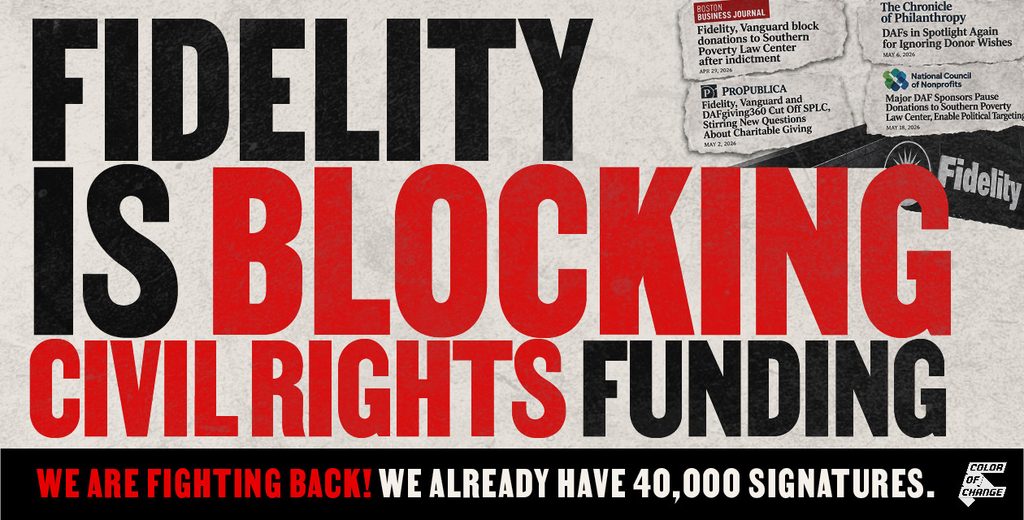
Then, before a court or jury heard a word, Fidelity Charitable blocked its donors from sending money to SPLC through their donor-advised funds, or DAFs, one of the largest sources of charitable giving in the country.
More than 40,000 people have already signed our petition demanding Fidelity1 reverse course. Fidelity’s Board meets this October, and Color Of Change will be there to deliver those signatures in person. We want your name on that petition when we do.
After Fidelity moved first, Vanguard Charitable, Charles Schwab’s DAFgiving360, Goldman Sachs Gives and Thrivent Financial followed. Benevity, the workplace giving platform much of the Fortune 500 uses to process employee donations and company matches, has frozen gifts to SPLC too, so workers who choose to give through their paychecks, no longer can.
Plenty of donor-advised fund sponsors have not frozen funding to SPLC, and Groundswell, a workplace-giving platform, has kept honoring those gifts. Nothing is stopping Fidelity from doing likewise, other than Fidelity’s own policies, which have been interpreted differently for right-wing organizations.
No court has found SPLC guilty of anything, yet despite the presumption of innocence fundamental to our justice system, Fidelity has led the charge to punish SPLC before a jury hears any evidence. SPLC’s trial has been delayed to next year, leaving SPLC without funding from DAFs for more than a year.
Our message to the board is simple: Fidelity cannot blacklist civil rights organizations and build the machinery Trump needs to silence the groups willing to stand up to him.
Financial chokepoints have a racist history:
Getting money to Black organizers has never been simple or safe. Attacks on civil rights have long included attacks on the money that makes organizing possible: wages, business credit, charitable contributions, and the services organizations need to keep working.
In 1964, the Student Nonviolent Coordinating Committee was 72 hours from running out of money during Freedom Summer. Harry Belafonte raised $70,000 for them and would not wire it — he believed sending a Black organizer to collect a transfer in Mississippi could get that organizer killed. So Belafonte and Sidney Poitier carried the cash to Greenwood themselves. Klansmen tried to run their car off the road, but they still delivered the money.
What has changed is the chokepoint. In 1964, it was a wire office in Mississippi. Today it’s a giving platform in Boston. But there are numerous similar incidents:
The FBI invents fraud allegations and sends them to SNCC’s funders
The FBI tried to undermine SNCC’s funding by making up financial misconduct. Congressional investigators found that the Bureau sent the Episcopal Church letters falsely accusing the organization of planning to use fictitious school-supply orders to steal grant money. (Church Committee, Book III, p. 56)
The letters pretended to come from local businesspeople, disguising a government operation as an outside warning. A second effort targeted SNCC’s proposed agricultural work, sending fabricated kickback allegations to the Interreligious Foundation for Community Organizing. (Church Committee, p. 56, citing June 18 and August 19, 1970 memoranda)
That history should shape how funders respond when racial justice organizations come under attack. An accusation must not become an automatic cutoff of support, and a donor’s concern about accountability must not be manipulated into helping disable the work they intended to fund.
The campaign against Martin Luther King Jr reaches his donors
The campaign against Martin Luther King Jr. reached the people and institutions financing civil rights work. Congressional investigators documented FBI efforts to interfere with church support, prospective union funding, and fundraising for King’s Washington campaign. (Church Committee, Book III, pp. 142, 176–177, 181)
Andrew Young testified that agents told major contributors false stories about a Swiss bank account and diverted march funds. (Church Committee, pp. 183–184) King’s lawyer Harry Wachtel explained the consequences: “A grant delayed has a very serious impact” on an organization already struggling financially. (Church Committee, p. 183)
For an organization defending civil rights, delayed support can be a serious injury. We should not ask organizations to absorb financial punishment while they spend their time and resources fighting politically driven attacks. Funders and financial institutions have a responsibility to make independent, evidence-based decisions.
The Black Panthers: The FBI pressured businesses supporting free breakfasts
The FBI tried to cut off business support for the Black Panther Party’s free breakfast program. It sent anonymous letters and inflammatory material to Safeway, Mayfair Markets, and Jack-In-The-Box with the stated aim of impeding their contributions. (Church Committee, Book III, p. 210)
The pressure extended to people providing space and support. In San Diego, anonymous FBI letters and calls targeted Father Frank Curran through his bishop, including threats to stop church contributions; the Bureau later reported Curran’s transfer and the breakfast program’s nonrenewal. (Church Committee, pp. 210–211)
This is why corporate decisions about donations matter beyond a company’s own balance sheet. When institutions withdraw the resources that sustain community programs, the people relying on those programs bear the consequences. Businesses must not become instruments for punishing communities because officials oppose the organizations serving them.
Tent City: A blacklist punished Black families for registering to vote
In Tennessee’s Fayette and Haywood Counties, Black residents who registered to vote faced a circulated blacklist used to deny goods, gasoline, bank loans, and employment. Landlords evicted families or refused to renew their tenancies, helping create the Tent City movement of the early 1960s. (Swarthmore history of the Tent City campaign)
The reprisals reached across daily life, linking access to work, credit, supplies, and shelter to political participation. (Swarthmore) Families and their supporters sustained the campaign through relief and litigation; in United States v. Beaty, a federal appeals court extended protection against voter intimidation to retaliatory landlord evictions. (Yale Law Journal, “Private Economic Coercion”)
A blacklist does not need to take away a right on paper to make exercising it costly. That is why we must confront financial exclusion as a civil rights issue, rather than treat each denial as an isolated business decision.
Why this matters now – and why it should matter to you:
Regardless of whether you contribute to a DAF, have access to one, or even own one, the fact remains that they are being used against comprehensive social, economic and racial justice. While everyday Americans struggle to provide for their families, Trump is going after the organizations that are working to defend and show up for them. Withholding funds from progressive civil rights organizations impacts Americans in multiple ways across every aspect of their daily lives. Civil rights organizations fight for communities every day, and this work can’t be interrupted.
Absolutely no social or civil rights organization and the crucial work they do should be sabotaged simply because those in power do not value their work.
That is not how democracy works.
That is not how social progress works.
That is not how we, as a country, grow and establish fair and equitable spaces for all.
And that’s where you come in.
What you can do about it:
The easiest and most feasible thing you can do right now is not be silent. We need everyone to be talking about this issue with their families, their friends, their coworkers, anybody who will lend an ear. The greater the public consciousness is around Fidelity’s actions, the greater Fidelity will feel the pressure. Here is a digital toolkit to help you do just that.
If you do have a DAF with Fidelity, now’s the time to reach out to them and ask them to stop withholding funds from the Southern Poverty Law Center and stop blacklisting civil rights.
You can also sign out petition to demand Fidelity to reverse its course!
- Fidelity refers to Fidelity Investments and Fidelity Charitable, an independent public charity governed by its own trustees and established by Fidelity Investments.

